About your shoulder
The shoulder joint is a ball and a shallow socket joint. It is formed from a ball on the top of your arm bone and a shallow socket which is part of the shoulder blade.
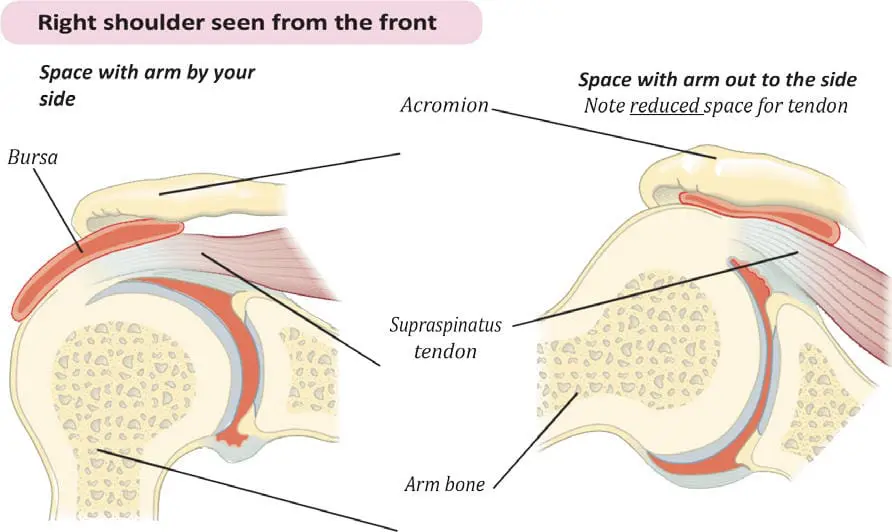
Above the ball and socket joint is a ligament which is attached to a bony prominence (‘acromion’) on your shoulder blade. This forms an arch. The area between the shoulder joint and the arch is known as the sub-acromial space.
To move your shoulder and control the position of the ball on the socket, you have a group of muscles and tendons known as the rotator cuff. They attach from the shoulder blade onto the top of the arm bone, passing through the sub-acromial space. One tendon (‘supraspinatus’) sits in the middle of the sub-acromial space. A small fluid lining (‘bursa’) cushions the tendon from the roof of the arch.
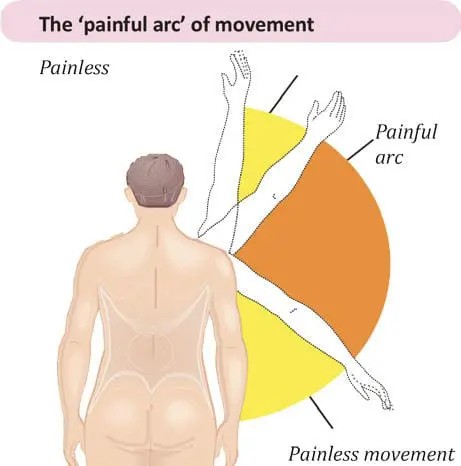
When you move your arm away from your side, the rotator cuff works to keep the ball centred on the socket. When your arm reaches shoulder height (horizontal), the sub-acromial space is narrowed. Above and below the horizontal, the space is larger.
What is impingement?
The rotator cuff appears to be vunerable to tendon damage or degeneration (wear and tear). This particularly affects the supraspinatus tendon in the subacromial space. Unfortunately this is more likely as we get older.
Damage to the tendon(s) can range from inflammation to tears. It’s not know why some people are susceptible to having these problems. Sometimes there is a precipitating event that makes the shoulder painful.
For example over-use, a new (overhead) arm activity such as DIY, pruning or hedge trimming in the garden, carrying luggage. This may cause irritation of the tendon which gives pain and weakness. Once the tendon becomes affected, it swells, filling more of the space, which increases the chance of the tendon and bursa becoming pinched – known as ‘impingement’. Anything that narrows the space between the rotator cuff and the arch above will tend to pinch and irritate the cuff.
Tears in the tendon can occur from sudden injuries such as falling, but more commonly they develop gradually, as a wear-and-tear effect on the tendon. This is partly age related, but may result from longstanding impingement. The tears can be partial or full thickness.
How common is it?
Extremely! It is the most common problem of the shoulder. 20% of people will have symptoms at some time in their lives and it most frequently begins in middle age (ages 45 to 65) and there is a higher incidence in females.
What are the symptoms?
The main complaint is one of pain, often felt on the outside of the upper arm. A classic presentation is of a painful arc on movement when the arm is lifted out to the side and up to your ear. This corresponds with the narrowing of the sub-acromial space. Pain is also commonly felt on twisting movements such as putting jackets and coats on. When the inflammation is active, you may experience pain at night and when your arm is resting. Sometimes people describe a ‘locking’ sensation in the arm on certain movements.
How is it diagnosed?
The main way to diagnose shoulder impingement is from your symptoms and by orthopedic assessment of your shoulder.
If there is some suspicion that the tendon is torn, you will be referred for an ultrasound scan or an MRI (Magnetic Resonance Image). Both of these scans show the tendons, and can highlight if they are torn.
How is it treated?
Osteopathy is particularly helpful in the treatment of shoulder Impingement, Rotator cuff problems and Frozen Shoulder. A range of techniques and exercises are used by our team in order to reduce pain and increase the range of motion in the joint.